
Business Loan vs Line of Credit Australia: Term Loan or Working Capital Facility for Your SME?
16 October 2025
Picture this: your Sydney-based manufacturing business spots a prime opportunity to buy new machinery that will boost production by 30 percent. You need a solid chunk of cash upfront, with repayments spread predictably over time. Or maybe your retail store in Melbourne deals with seasonal spikes, where stock arrives before customer payments do, creating short-term cash squeezes that come and go. These scenarios capture the heart of the business loan vs line of credit Australia debate for small and medium enterprises (SMEs).
Australian SME owners often grapple with these choices when funding growth or smoothing operations. A term loan might suit a defined project, while a working capital line of credit could handle uneven cash flow. This guide breaks it down practically, helping you weigh options without prescribing a one-size-fits-all path. Product features vary by provider, so use this as a lens for your circumstances.
What a Term Business Loan Often Looks Like
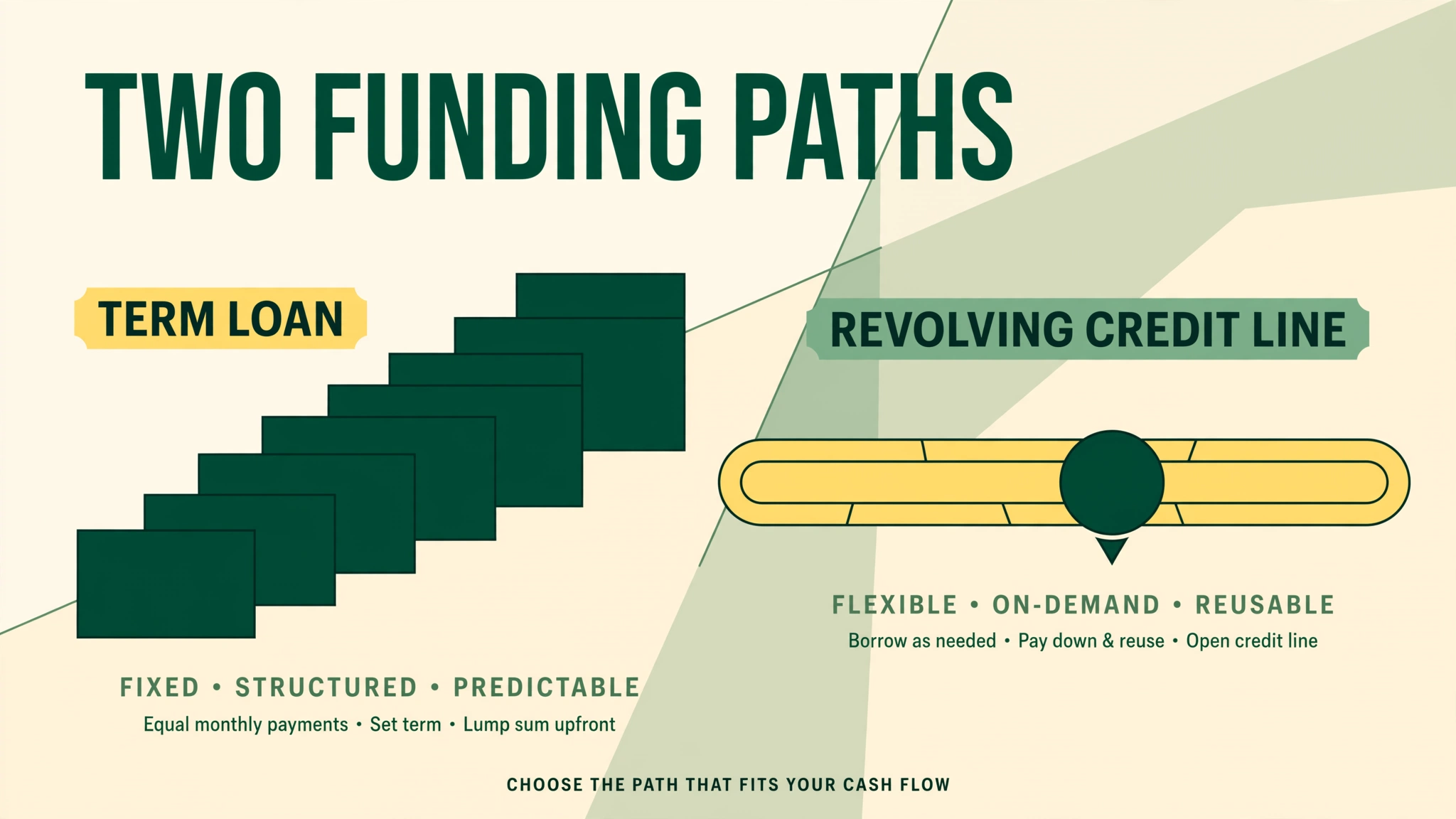
A term business loan typically provides a lump sum upfront, repaid over a fixed schedule. Think of it as a structured advance for a specific purpose, like funding a shop fit-out, bridging an equipment purchase, or supporting a one-off expansion.
Funds are disbursed once, often with monthly principal-and-interest repayments over one to five years or more. This setup offers certainty: you know the total amount borrowed and the repayment timeline from day one. Providers may require security or personal guarantees, depending on your business profile.
- Clear end date to the debt.
- Suits projects with predictable timelines and returns.
- Interest calculated on the full amount from drawdown.
Understanding a Working Capital Line of Credit for SMEs
In contrast, a working capital line of credit SME facility offers a revolving credit limit, much like a business overdraft on steroids. You draw funds as needed, up to the approved limit, and repay them to reuse the facility. It's handy for variable needs such as stocking up for peak seasons, covering payroll during slow invoice payments, or handling unexpected short-term gaps.
Interest usually applies only to the amount drawn, not the full limit. Repayments can be flexible, often interest-only on outstanding balances, with the principal reducing as you repay. This term loan or revolving credit Australian business option shines when cash flow ebbs and flows predictably but unevenly.
- Pay interest only on what you use.
- Reusable once repaid.
- May have annual fees or minimum draw requirements.
Decision Factors: One-Off Needs vs Ongoing Flexibility
A Simple Qualitative Comparison
General characteristics only; features vary by provider.
| Aspect | Term Loan | Line of Credit |
|---|---|---|
| Often used for | Defined projects like equipment or expansions | Cash flow gaps, stock, payroll timing |
| Funds access | Lump sum upfront | Draw and repay as needed |
| Repayment shape | Fixed schedule | Flexible, on drawn balance |
Consider the duration of your need. A term loan fits finite goals with a known payback path. A line of credit suits repeating cycles where flexibility trumps structure. Ask: Do I want discipline in repayments or agility in access?
Costs, Fees, and the Discipline Factor
Costs depend on the provider, your business health, and market conditions. Term loans often charge interest on the entire borrowed amount from the start, plus possible establishment or ongoing fees. Lines of credit may bill interest solely on drawn funds, but watch for unused line fees or minimum usage clauses that encourage discipline.
Either way, treat them as tools requiring oversight. Over-reliance on flexible credit can mask underlying issues, while rigid loan repayments demand steady cash flow.
Documents to Strengthen Your Case
- Active ABN and business details.
- Recent BAS statements showing turnover.
- Three to six months of bank statements.
- Clear explanation of fund use.
Having these ready smooths discussions with lenders, regardless of product.
Unsure Which Fits? Start with an Enquiry
No need to commit upfront. FundingMatch lets you enquire across categories like Business Loans, Working Capital / Line of Credit, or simply "not sure." An enquiry is not a loan application, quote or guarantee. With your consent, it may be shared with selected providers or brokers who may contact you; each provider decides whether to respond and sets its own eligibility, products and terms.
FAQ: Business Loan vs Line of Credit Australia
Can I switch from one to the other?
Possibly, but it depends on provider terms and refinancing options. Discuss with specialists.
Which has lower costs?
Varies widely; compare based on your usage and provider offers.
Do I need assets as security?
Security requirements vary by product and provider.
Next Steps for Your SME Funding
Ready to clarify your options? Submit a no-obligation enquiry at FundingMatch. There is no obligation to proceed. Note: This is general information, not financial advice. FundingMatch is not a lender and does not guarantee rates or approvals. Enquiries are not applications.
Choose the facility that aligns with your cash flow rhythm, not the other way around.